Established in 2002, ESPASSO is committed to conserving Brazil's rich 20th century design heritage and expanding its global reach, while promoting new creative generations and today's leading designers.
Present in New York, Los Angeles, Miami and London, the gallery represents mid-century modern and contemporary Brazilian designers, and has consolidated itself as a thriving outpost for architects, interior designers, artists, collectors and museum curators, to engage in education and exchange.
The brand has acquired global recognition for its curatorial vision and impeccable services, representing works of the finest execution and enduring cultural relevance.

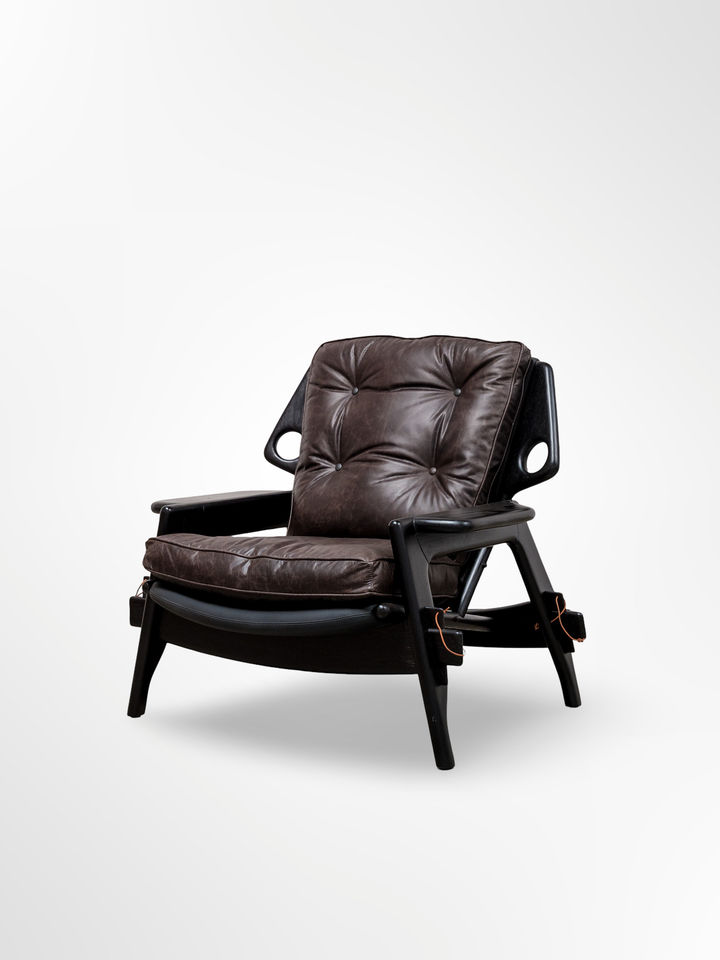
More than fifty years separate Jorge Zalszupin’s original drawings for the Anette armchair from the name it bears today. Designed in the 1960s, the chair remained largely unknown, with only a handful of prototypes produced, until Zalszupin’s family rediscovered the design and brought it to Etel Carmona. When ETEL reissued the armchair in 2014, it was named Anette in honor of the designer’s wife, Annette. The family’s involvement in bringing this forgotten design back to life adds a personal dimension to its history and invites a closer look at the chair itself. Beneath the cushions, leather straps wrap around black iron bars, revealing the chair’s supporting structure. The slender metal frame follows the contours of the upholstery, creating a sense of openness and lightness. The wooden armrests introduce a gentle curve to this geometry. Long and subtly upturned at the ends, they highlight the natural grain of the wood and the careful craftsmanship of the surfaces that come into contact with the body. This interplay between structural precision and organic lines reflects Zalszupin’s sensitivity to proportion, materials, and comfort. The reissue brings these qualities into everyday use, from the natural placement of an arm along the wood to the body settling into the cushions. It is through these subtle interactions that the chair’s thoughtful construction and attention to detail become most apparent. Anette Lounge Armchair - Jorge Zalszupin, 1960 | Reissued by ETEL Photos captured by @franparente and @eliseucavalcante

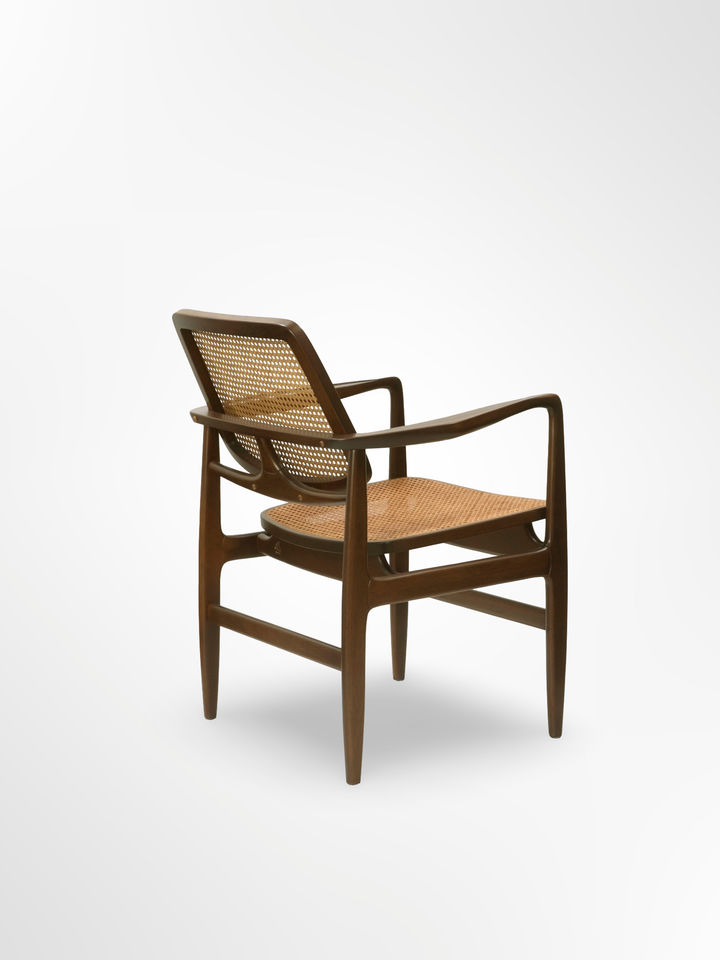
Modern homes called for a new way of thinking about furniture. In São Paulo in 1952, six architects came together around that idea: Plinio Croce, Roberto Aflalo, Carlos Millan, Miguel Forte, Jacob Ruchti, and Chen Y Hwa founded Branco & Preto, bringing the same care to designing furniture that they brought to the spaces it would occupy. As they moved from architecture into furniture design, their understanding of proportion and structure found expression in traditional woodworking. Wood and cane defined a design language that we explore here through three of the group’s pieces, all reissued by ETEL: the Aranha Coffee Table, MF5 Lounge Armchair, and Palhinha Dining Chair. The Aranha’s simple three-legged structure invites a closer look at how its supports balance one another. In the MF5, the sweeping curves of the wooden arms introduce a sense of movement, while the caned back lets light through. The Palhinha carries that openness into both its seat and back, set within a slender wooden frame, with rounded legs that taper toward the floor. Seen together, the three pieces reveal how Branco & Preto applied architectural thinking to furniture, working at the scale of the body and responding to the needs of everyday life. Discover Branco & Preto at ESPASSO. MF5 Lounge Armchair - Branco & Preto, 1953 | Reissued by Etel Aranha Coffee Table - Branco & Preto, 1950 | Reissued by Etel Palhinha Dining Chair - Branco & Preto, 1952 | Reissued by Etel

Ricardo Fasanello’s early ambition was to build race cars. He designed automotive seats and later drew on his ergonomic studies when developing his lounge chairs. The Esfera armchair reflects this attention to the seated body. Its hemispherical fiberglass shell surrounds thick cushions, with a continuous curve that your eye can follow around the exterior. A swivel base lets you change direction without leaving your seat. From across the room, the Esfera draws the eye with its sculptural shape and resin finish. Up close, the spacious seat invites a closer look at how the chair accommodates the body. Once you sit down, the rounded shell surrounds you, and the generous cushions offer room to settle in and stay a while. Esfera Lounge Armchair - Ricardo Fasanello, 1970 Cover photo by @leonardofinotti

At first glance, the Mantas Soltas Armchair seems to be made of folded blankets over a wooden frame. Its name captures that impression: in Portuguese, “mantas” means blankets, and “soltas” means loose. Designed by Joaquim Tenreiro in 1960 and reissued by ETEL , the chair’s upholstery forms the seat and folds over the arms before rising into the backrest. The turned solid wood is visible beneath and around the upholstery. This design reflects Tenreiro’s attention to woodworking, texture, and the balance of form. The rounded wooden elements support the upholstery and define its contours, revealing the careful construction that gives those seemingly loose blankets hold their shape. Mantas Soltas Armchair - Joaquim Tenreiro, 1960 | Reissued by ETEL Photos captured by @eliseucavalcante

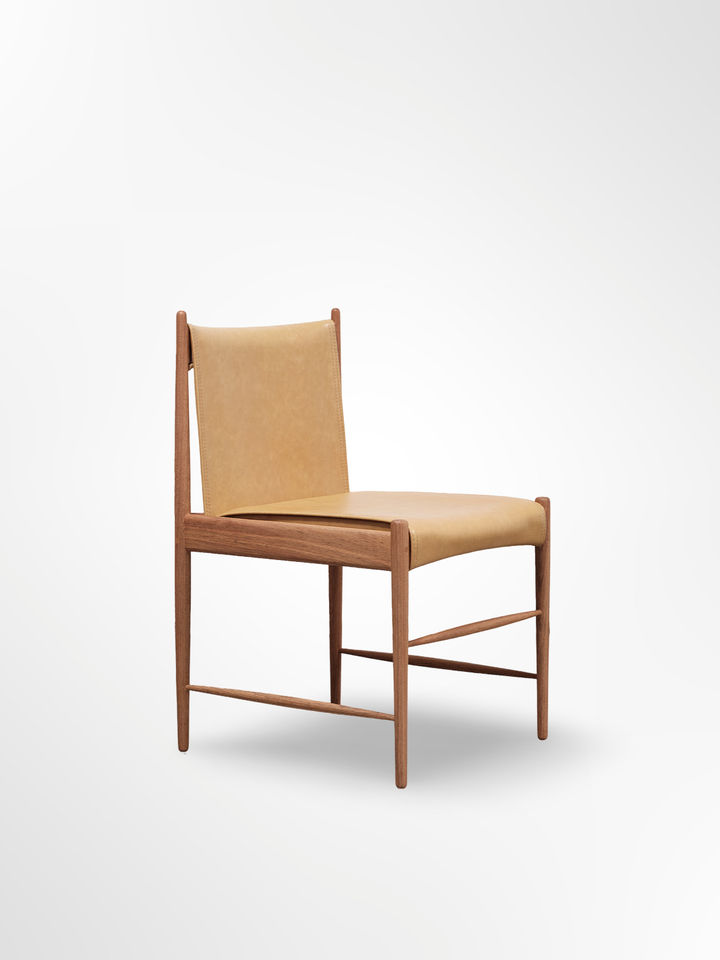
An early design by Sergio Rodrigues, the Cantu dining chair dates to 1958 and pairs a solid wood frame with a seat and back upholstered in leather or fabric. Named after the Italian town where it earned third prize at the IV International Furniture Competition, the chair belongs to the formative years of Rodrigues’s work in Brazilian modernism. The ESPASSO Apartment was designed and curated by @tangible.space Photos captured by @ben__dehaan and @eliseucavalcante

ESPASSO and Sergio Rodrigues’s studio share a longstanding partnership. In 2011, that collaboration expanded with the opening of a permanent exhibition dedicated to his furniture at ESPASSO’s Tribeca gallery, introducing American audiences to the breadth of his work. On what would have been his 99th birthday, we celebrate a designer who helped shape Brazilian furniture and whose influence extends well beyond individual pieces. Today, we revisit his work through two lifelong passions: furniture and drawing. His sketches offer insight into his creative process, revealing the precision, humor, and affection that characterized his work. Photos captured by @eliseucavalcante and @billypavone Archives of @sergiorodriguesatelier and @institutosergiorodrigues

The Curves of Brazilian Modernism: Onda, Marquesa and Copan Benches The curve has long been an important element of Brazilian furniture design, closely tied to the architectural language of Brazilian modernism and its exploration of fluid, expressive forms. Designed by Jorge Zalszupin in 1960, when L’Atelier was producing furniture for public buildings in Brasília, Brazil’s newly built capital, the Onda Bench reflects this relationship. A continuous sheet of molded wood forms the seat and extends into a leather magazine holder. Today, Etel reissues the piece. In 1974, Oscar Niemeyer and his daughter Anna Maria designed the Marquesa Bench, bringing the curves so present in Niemeyer’s architecture into furniture. Its long, sweeping frame and woven cane seat give the piece a sense of movement while keeping its construction remarkably simple. The Marquesa is also reissued by Etel. Ronald Sasson’s Copan Bench, designed in 2019, makes the architectural reference explicit. Named after Niemeyer’s Edifício Copan in São Paulo, its solid wood form echoes the rhythmic curves of the building’s façade. Designed nearly six decades apart, the Onda, Marquesa, and Copan benches show how the curve continues to reappear in Brazilian design, interpreted by different designers, and through different materials and at different moments. All the while, they maintain a close relationship between form, structure, and movement. 1, 2: Marquesa Bench — Oscar Niemeyer, 1974 | Reissued by Etel 3, 4: Onda Bench — Jorge Zalszupin, 1960 | Reissued by Etel 5, 6: Copan Bench — Ronald Sasson, 2019 Photos by @ben__dehaan , @eliseucavalcante, @macarios

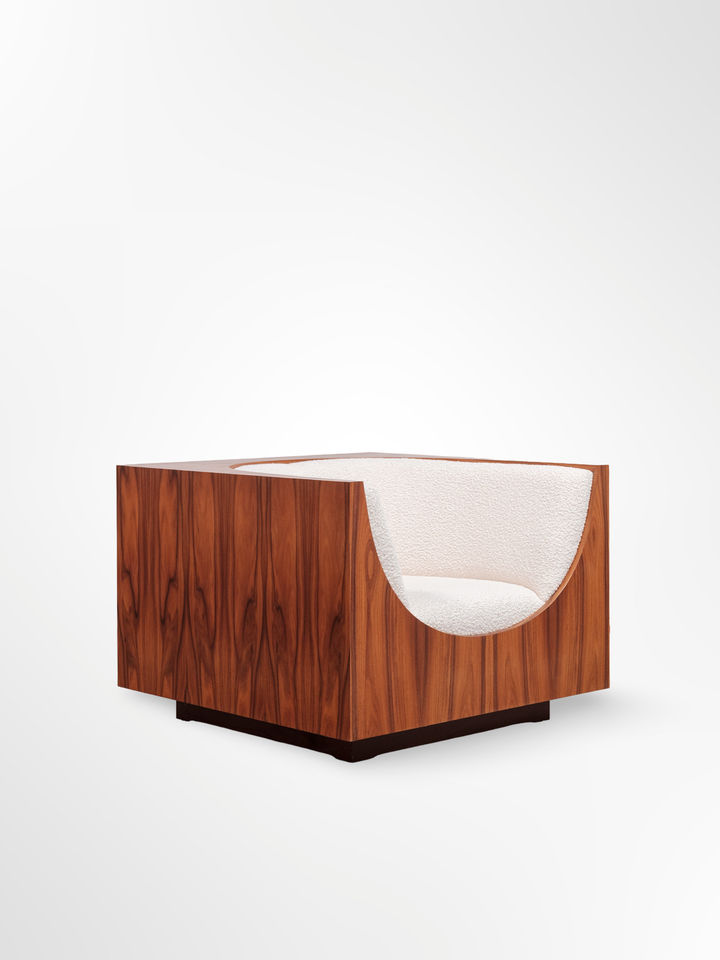
Designed in the late 1970s and reissued exclusively by ETEL, the Cubo Armchair belongs to Jorge Zalszupin’s collection of the same name. Its rigorous geometry marks a departure from the sinuous curves and intricate carved-wood details found throughout much of the designer and architect’s work. The chair is built around a solid, orthogonal structure defined by the precise proportions of a cube. The seat and backrest follow this geometric logic, with visible seams and topstitching emphasizing its clean lines and giving structure to the generous upholstery. The original Cubo was fully upholstered. Over time, the design was carefully revisited by the Zalszupin family archive. This re-edition introduces solid wood elements, adding a new material dimension to the piece while preserving the lightness of the collection and the integrity of Zalszupin’s original design. Cubo Lounge Armchair - Jorge Zalszupin, 1970 | Reissued by Etel Photos captured by @franparente; Etel Photos (@etel.design) Project by @bernardesarq